

True Christianity: Rome Against Christianity Part 3
- Titus1man
- Aug 15, 2021
- 6 min read
Updated: Dec 27, 2025
As Christianity began to take root in the Roman empire, the difference between Judaism and Christianity was clearly seen. While Rome recognized the Jewish religion, the Christian religion was not granted permission to exist. Therefore, a direct conflict began between Christianity and the most brutal and oppressive of all power, Rome. Of Rome the Bible states, “Then I would know the truth of the fourth beast, which was diverse from all the others, exceeding dreadful, whose teeth [were of] iron, and his nails [of] brass; [which] devoured, brake in pieces, and stamped the residue with his feet”.(Daniel 7:19 [KJV])
A fundamental maxim of Roman legislation was, — “No man shall have for himself particular gods of his own; no man shall worship by himself any new or foreign gods, unless they are recognized by the public laws.” — Cicero. [Page 348] Quoted in Neander’s “History of the Christian Religion and Church,” sec. i, div.iii, par. 2.
It is very evident that in such a system there was no place for individuality. The State was everything, and the majority was in fact, the State. What the majority said should be, that was the voice of the State, that was the voice of “God”, that was the expression of the highest good, that was the expression of the highest conception of right; and everybody must assent to that or be considered a traitor to the State. The individual was but a part of the State. There was therefore no such thing as the rights of the people; the right of the State only was to be considered, and that was to be considered absolute. “The first principle of their law was the paramount right of the State over the citizen. Whether as head of a family, or as proprietor, he had no natural rights of his own; his privileges were created by the law as well as defined by it. The State in the plenitude of her power delegated a portion of her own irresponsibility to the citizen, who satisfied the conditions she required in order to become the parent of her children; but at the same time she demanded of him the sacrifice of his free agency to her own rude ideas of political expediency.” –– Merivale. [Page 349] “Romans under the Empire,” chap. xxii, par.21.
It is also evident that in such a system there was no such thing as the rights of conscience; because as the State was supreme also in the realm of religion, all things religious were to be subordinated to the will of the State, which was but the will of the majority. And where the majority presumes to decide in matters of religion, there is no such thing as rights of religion or conscience. Against this whole system Christianity was diametrically opposed. — {1898 ATJ, Great Empires of Prophecy (GEP) 349.2}
Christ had set himself before His disciples as the one possessing all power in heaven and in earth. He had told them to go into all the world and teach to every creature all things whatsoever He had commanded them. Christ had said that the first of all the commandments, that which inculcates the highest and first of all duties is, “And thou shalt love the Lord thy God with all thy heart, and with all thy soul, and with all thy mind, and with all thy strength:…”(Mark 12:30 [KJV]) This put Jesus Christ above the State, and put allegiance to Him above allegiance to the State; this denied the supremacy of Rome, and likewise denied either, that the Roman gods were gods at all, or that the genius of Rome itself was in any sense a god. {1898 ATJ, GEP 350.1}
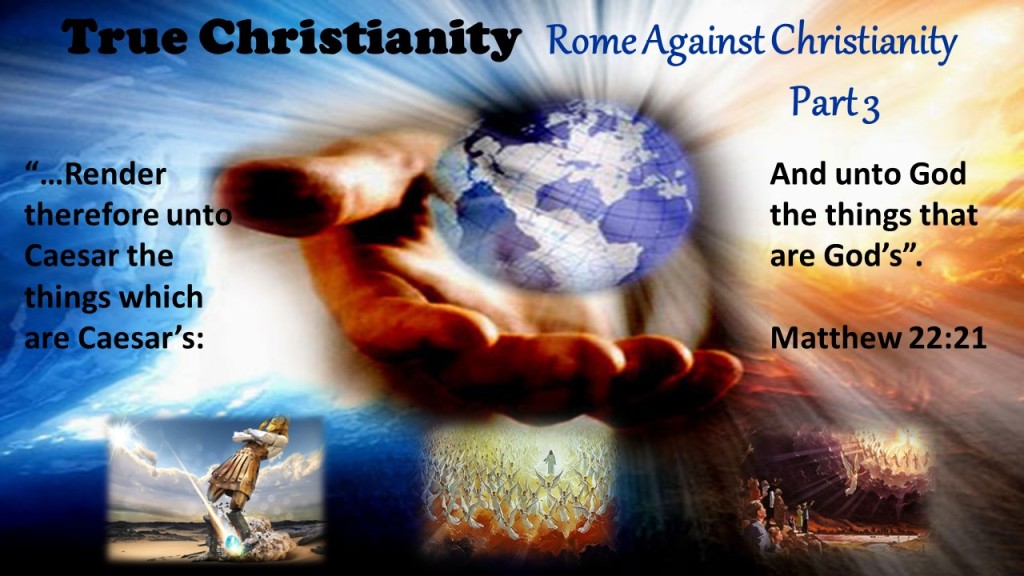
Christ when asked by the Pharisees and the Herodians whether it was lawful to give tribute to Caesar or not, answered: “Render therefore unto Caesar the things which are Caesar’s; and unto God the things that are God’s.” (Matthew 22:21 [KJV]) In this, Christ established a clear distinction between Caesar and God, and between religion and the State. He separated that which pertains to God from that which pertains to the State. Only that which was Caesar’s was to be rendered to Caesar, while that which is God’s was to be rendered solely to God.
Therefore when Christ made this distinction between God and Caesar, separated that which pertains to God from that which pertains to Caesar, and commanded men to render to God that which is God’s, and to Caesar only that which is Caesar’s, He at once stripped Caesar — the State — of every attribute of divinity. And in doing this, He declared the supremacy of the individual conscience; because it rests with the individual to decide what things they are which pertain to God. {1898 ATJ, GEP 350.4}
Thus Christianity proclaimed the right of the individual to worship according to the dictates of his own conscience; Rome asserted the duty of every man to worship according to the dictates of the State. Christianity asserted the supremacy of God; Rome asserted the supremacy of the State. Christianity set forth God as manifested in Jesus Christ as the chief good; Rome held the State to be the highest good. Christianity set forth the law of God as the expression of the highest conception of right; Rome held the law of the State to be the expression of the highest idea of right. Christianity taught that the fear of God and the keeping of His commandments is the whole duty of man; Rome taught that to be the obedient servant of the State is the whole duty of man. Christianity preached Christ as the sole possessor of power in heaven and in earth; Rome declared the State to be the highest power. Christianity separated that which is God’s from that which is Caesar’s; Rome maintained that that which is God’s is Caesar’s. {1898 ATJ, GEP 351.1}
With the distinction clearly made, to profess Christianity made you an enemy of the state, but such was the calling. “And they overcame him by the blood of the Lamb, and by the word of their testimony; and they loved not their lives unto the death”. (Rev 12:11 [KJV])
Rome had a pantheon of gods, and every act of life was associated with the gods. Every Christian, merely by the profession of Christianity, severed himself from all the gods of Rome and everything that was done in their honor. He could not attend a wedding or a funeral of his nearest relatives, because every ceremony was performed with reference to the gods. He could not attend the public festival, for the same reason. Nor could be escape by absenting himself on such occasions; because on days of public festivity, the doors of the houses, and the lamps about them, and the heads of the dwellers therein, must all be adorned with laurel and garlands of flowers in honor of the licentious gods and goddesses of Rome. If the Christian took part in these services, he paid honor to the gods as did the other heathen. If he refused to do so, which he must do if he would obey God and honor Christ, he made himself conspicuous before the eyes of the people, all of whom were intensely jealous of the respect they thought due to the gods. Also, in so refusing, the Christians disobeyed the Roman law, which commanded these things to be done. {1898 ATJ, GEP 358.1}
All this subjected the Christians to universal hatred, and as the laws positively forbade everything that the Christians taught, both with reference to the gods and to the State, the forms of law furnished a ready channel through which this hatred found vent. This was the open way for the fury of the populace to spend itself upon the “deniers of the gods, and enemies of the Caesars and of the Roman people.” And this was the source of the persecution of Christianity by pagan Rome. {1898 ATJ, GEP 358.2}
One of the ruling principles of law in the Roman State was this: — {1898 ATJ, GEP 359.4}
“Whoever introduces new religions, the tendency and character of which are unknown, whereby the minds of men may be disturbed, shall, if belonging to the higher rank, be banished; if to the lower, punished with death.” {1898 ATJ, GEP 359.5}
Nothing could be more directly condemned by this law than was Christianity. {1898 ATJ, GEP 359.6}
In spite of all this, Christianity flourished till it was said; “If ye continue in the faith grounded and settled, and [be] not moved away from the hope of the gospel, which ye have heard, [and] which was preached to every creature which is under heaven; whereof I Paul am made a minister;(Col 1:23 [KJV])
True Christianity was not only willing to suffer reproach but die for the sake of the gospel. Are you a true Christian?
“But what things were gain to me, those I counted loss for Christ. Yea doubtless, and I count all things [but] loss for the excellency of the knowledge of Christ Jesus my Lord: for whom I have suffered the loss of all things, and do count them [but] dung, that I may win Christ”. (Phil 3:7-8 [KJV])


Comments